
Plant Coordination ETAP: Improving Electrical Protection in Industrial Facilities
Industrial facilities depend on complex electrical distribution systems to keep equipment running safely and reliably. Motors, transformers, switchgear, circuit breakers, relays, fuses, and other components must work together to deliver power while also responding correctly when an electrical fault occurs.
This is where Plant Coordination ETAP studies can play an important role.
Using ETAP power system analysis software, engineers can model an industrial electrical system, evaluate fault conditions, and analyze how protective devices respond throughout the facility. The goal is not simply to shut off power when a problem occurs. A properly coordinated system is designed to isolate the fault as selectively as possible while allowing unaffected portions of the facility to remain operational.
For manufacturing plants and other industrial operations where downtime can have significant consequences, proper electrical coordination can be an important part of designing and maintaining a reliable power system.
What Is Plant Coordination ETAP?
Plant Coordination ETAP refers to the use of ETAP software to model and evaluate protective device coordination within a plant's electrical distribution system.
Protective devices such as circuit breakers, relays, and fuses are installed throughout an electrical system to respond to abnormal current conditions. The challenge is making sure these devices operate in the correct sequence.
Consider a simplified industrial distribution system:
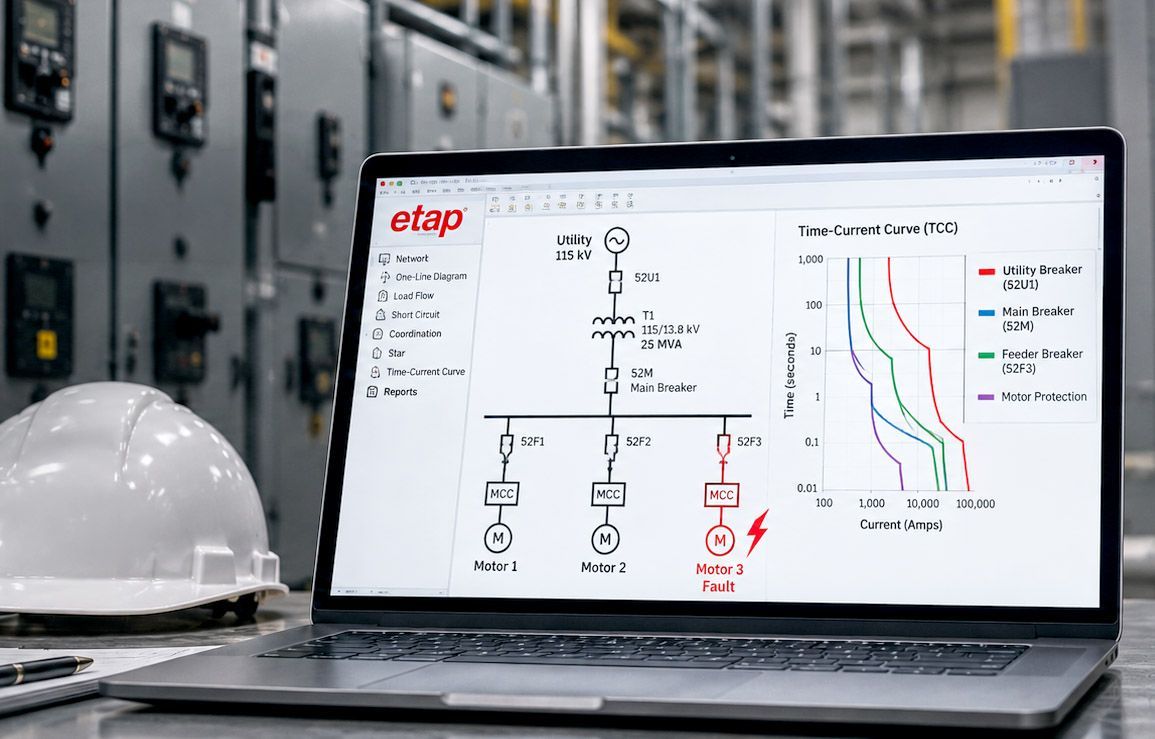
Utility - Main Switchgear - Distribution Panel - Motor Control Center - Motor
If an electrical fault occurs at the motor, the ideal response is typically for the protective device closest to that motor to clear the fault. If an upstream main breaker trips unnecessarily, a relatively localized problem could instead interrupt power to a much larger portion of the plant.
A Plant Coordination ETAP study allows engineers to evaluate these relationships and determine whether protective devices are properly coordinated.
Why Is Protective Device Coordination Important?
Electrical protection requires a balance between protecting equipment and maintaining system reliability.
The National Institute of Standards and Technology defines a coordination study as a study used to determine appropriate protective-device settings to support the reliability of a power distribution system. NIST also notes the need to balance adequate protection against overprotection that can cause nuisance tripping and negatively affect system reliability.
That balance is especially important in industrial environments.
A manufacturing plant may contain production lines, process equipment, pumps, compressors, control systems, material handling equipment, and other critical loads. An unnecessary trip upstream can potentially affect equipment far beyond the original fault.
Proper coordination helps engineers design the protection system so faults can be isolated without unnecessarily removing healthy portions of the electrical system from service.
How Does ETAP Help with Plant Coordination?
Industrial electrical systems can contain hundreds or even thousands of interconnected components. Evaluating the interactions between all of those devices manually can become extremely complex.
A model may include components such as:
- Utility sources
- Generators
- Transformers
- Switchgear
- Switchboards
- Circuit breakers
- Protective relays
- Fuses
- Cables
- Bus systems
- Motor control centers
- Motors and other loads
Once the electrical system has been modeled, engineers can analyze how the system responds under different operating and fault conditions.
Plant Coordination ETAP analysis can therefore provide more than a drawing of the electrical system. It gives engineers a way to study the behavior of protective devices within the overall power distribution network.
Short-Circuit Analysis and Plant Coordination
A short-circuit study is often an important part of the coordination process.
When a fault occurs, the amount of available fault current can vary substantially depending on where the fault occurs and how the electrical system is configured. Engineers need to understand these fault-current levels when evaluating protective devices and their settings.
OSHA also specifies requirements related to coordinating protective-device operating time, available short-circuit current, and conductors to prevent damaging or dangerous temperatures under short-circuit conditions.
By performing short-circuit calculations within an ETAP model, engineers can evaluate available fault currents at different locations and use that information as part of the overall coordination study.
Understanding Time-Current Coordination Curves
One of the most useful tools in a Plant Coordination ETAP study is the time-current characteristic, or TCC, curve.
A TCC curve shows how quickly a protective device responds at different levels of current. Multiple protective devices can be plotted together, allowing engineers to visualize how downstream and upstream devices interact.
For example, a feeder breaker and main breaker should not necessarily respond to the same fault at exactly the same time.
For a downstream fault, engineers generally want the downstream protective device to clear the problem before the upstream device operates, assuming the system design and applicable requirements allow for that selectivity.
If the curves overlap in undesirable ways, engineers can investigate potential adjustments to settings or equipment.
This makes TCC analysis valuable for identifying coordination issues before they result in unnecessary outages.
What Can a Plant Coordination ETAP Study Identify?
A detailed coordination study can uncover issues that may not be obvious from reviewing electrical drawings alone.
Potential findings can include protective devices that operate too quickly, devices that do not provide the desired selectivity, settings that could cause unnecessary upstream trips, and areas where system modifications have changed fault-current characteristics.
This is particularly important in plants that have expanded over time.
Adding transformers, motors, generators, switchgear, or production equipment can change the electrical characteristics of the system.
Protective-device settings that were appropriate for the original facility may need to be reevaluated after significant modifications.
Keeping the ETAP model current provides engineers with a useful representation of the electrical system as the facility evolves.
Reducing the Impact of Electrical Faults
One of the biggest operational benefits of proper plant coordination is limiting the scope of an electrical interruption.
Imagine that a fault develops on one piece of production equipment. If the nearest protective device clears the fault as intended, the interruption may remain limited to that circuit or section of the system.
If protection is poorly coordinated, an upstream breaker could operate instead, potentially shutting down multiple pieces of equipment or an entire production area.
The electrical protection system cannot prevent every fault from occurring, but proper coordination can help control how the distribution system responds when a fault does happen.
For facilities where uptime directly affects production, this selectivity can be an important component of overall electrical reliability.
When Should Industrial Facilities Consider a Coordination Study?
A Plant Coordination ETAP study can be valuable during both the design of a new electrical system and the operation of an existing facility.
Facilities may consider performing or updating a study when installing new electrical equipment, expanding production, adding major loads, replacing switchgear, changing transformers, introducing onsite generation, or making other significant changes to the electrical distribution system.
Older plants can also benefit from reviewing existing coordination as electrical infrastructure changes over time.
The objective is to understand the system as it exists today rather than assuming settings developed for an earlier configuration remain appropriate.
Plant Coordination ETAP as Part of a Larger Power System Strategy
Protective device coordination does not exist in isolation. It can be part of a broader engineering approach that includes short-circuit studies, load flow analysis, arc flash analysis, equipment evaluation, and electrical system design.
When these studies are based on an accurate model, engineers gain a clearer understanding of how the plant's electrical infrastructure behaves under both normal and abnormal conditions.
For industrial facilities, that information can support decisions involving system expansion, equipment upgrades, protective-device settings, and long-term electrical reliability.
Plant Coordination ETAP Services for Industrial Facilities
Recore Electric provides electrical expertise for demanding industrial environments, where safety, reliability, and uptime are critical to operations.
Through Plant Coordination ETAP analysis, industrial facilities can better understand how protective devices interact across their electrical distribution systems. By modeling the system, analyzing fault conditions, reviewing TCC curves, and evaluating device coordination, engineers can identify opportunities to improve protection and reduce unnecessary interruptions.
As industrial electrical systems become larger and more complex, understanding how every component works together becomes increasingly important. Plant Coordination ETAP provides engineers with the tools to evaluate that system as a whole and develop a coordinated approach to electrical protection.